 Voyance
What card XIII really means
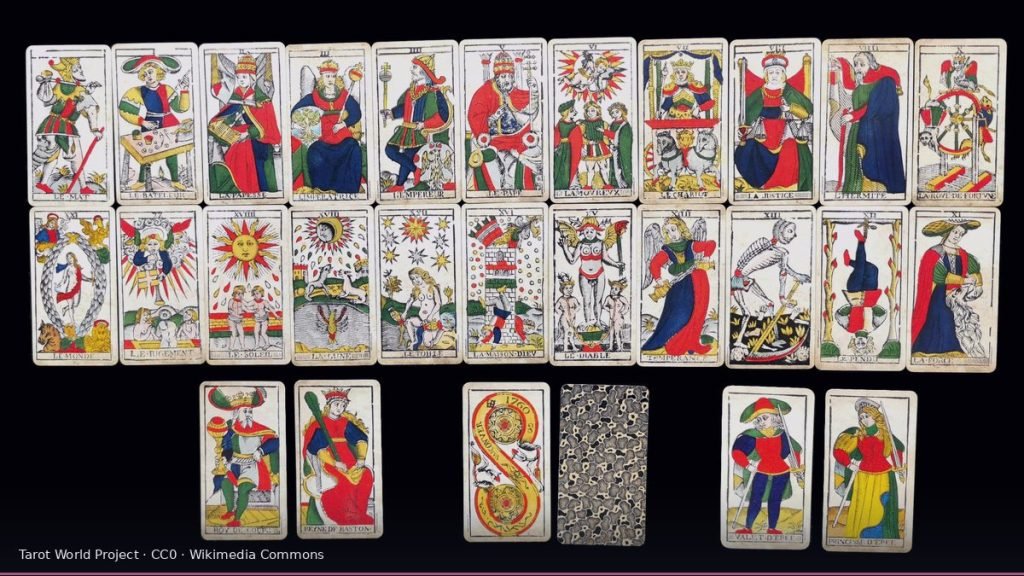
It is the card that unsettles people most — and the one readers almost always explain unprompted, before anyone asks.
It has no name
In the Marseille Tarot, no word appears beneath card XIII. All twenty-one other numbered cards are named.
This absence is no printer’s accident: it appears in every historical printing, from the Conver of 1760 onwards.
What the image shows
A skeleton with a scythe, mowing a field. Hands, feet and a head emerge from the soil — usually read as continuation, not as ending.
The scythe cuts, it does not destroy: the harvest belongs to the cycle of the year.
How it is read
As a transformation or a break. Something ends so that something else may begin.
Never as a literal event. This is not reassurance: it is the classical reading, found in every handbook.
What Chana would add: if this card comes up in your spread, look at the one that follows it. That card shows what the transformation moves towards — on its own, XIII only says that something is coming loose.
Why it unsettles
Because the image looks unambiguous while the missing name leaves room for supposition. That is precisely what makes it interesting in reading work.
See the cards and a consultation.
Frequently asked questions
Why does card XIII have no name?
The absence appears in every historical printing, from the Conver of 1760 onwards. It is not a misprint: it is part of the card.
What does it mean?
A transformation or a break: something ends so that something else may begin. Never a literal event.
What does the image show?
A skeleton with a scythe mowing a field. Hands and a head emerge from the soil, read as continuation.

Chana
I am an explorer of the human soul through the divinatory arts. Tarot, astrology, numerology, oracle cards—I love to look beneath the surface to decipher the messages the universe sends us.
contact@voyanceenligne.ch