 Voyance
The Marseille Tarot
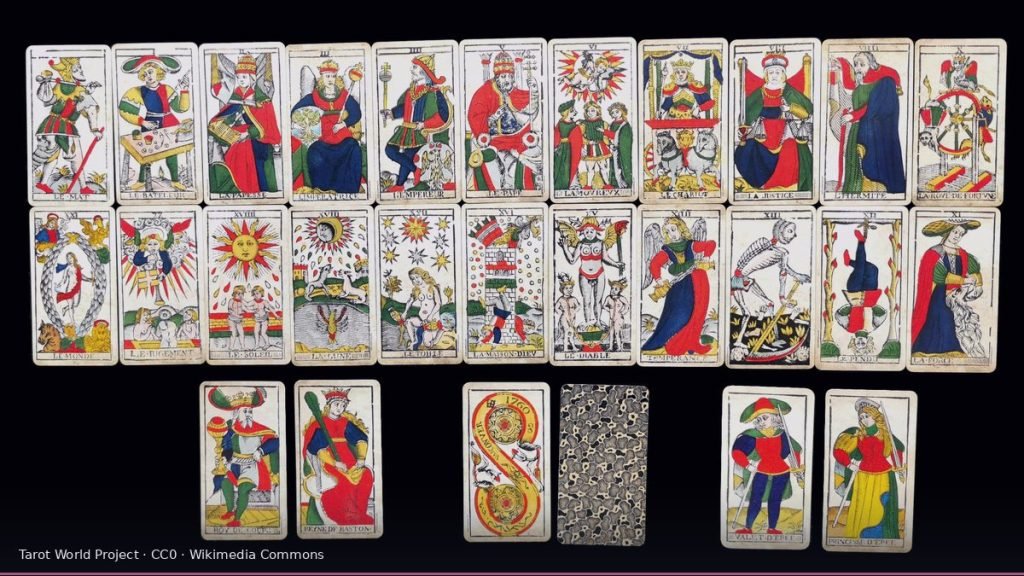
It is the reference deck of continental European cartomancy, and the one you are most likely to meet in Switzerland.
The structure
The 22 major arcana, numbered I to XXI, plus the Fool — the only card without a number. They carry the underlying movements.
The 56 minor arcana, in four suits — batons, cups, swords, coins — of fourteen cards each. They carry the concrete circumstances.
A majority of major arcana in a spread indicates, by tradition, a situation partly beyond you. It is the first thing a reader looks at.
Common spreads
Three cards, the most used. The arrangement situation – obstacle – advice gives more usable readings than the classic past-present-future.
The cross, five cards: four positions and a central synthesis.
The Celtic cross, ten cards. The spread for hour-long consultations.
Reversed cards
Does a card drawn upside down read differently? Schools disagree sharply: some see a contrary or weakened meaning, others always read upright.
What Chana would add: card XIII has no name in the Marseille Tarot, and it is the one that unsettles people most. Tradition reads it as a transformation, never as a literal event — and readers almost always explain it unprompted.
Read on
See the cards, a consultation and astrology.
Frequently asked questions
How many cards are in the Marseille Tarot?
Seventy-eight: twenty-two major arcana and fifty-six minor, across four suits of fourteen cards.
What does card XIII mean?
It has no name in the Marseille Tarot. Tradition reads it as a transformation, never as a literal event.
Do reversed cards change the meaning?
Schools disagree: some read a contrary or weakened meaning, others always read upright and draw the sense from neighbouring cards.