 Voyance
Tarot spread
Three cards, drawn from the 22 major arcana. The layout is the one readers use
most: situation, obstacle, advice.
Hold your question in mind, then draw.
Situation
what this is about today
Obstacle
what resists — or quietly helps
Advice
the angle the tradition suggests taking
This spread is a reading exercise, not a prediction. Cards are drawn at random and the readings given are those of the tradition.
Illustrations: Rider-Waite-Smith deck (1909), public domain.
Why this layout
The classic past – present – future rarely produces anything usable: the first
card tells you what you already know, the third what you cannot verify.
Situation, obstacle, advice gives you something to work with. The second card, laid
across the first in a real spread, marks what resists — and sometimes what quietly
helps.
What you are reading here
Each card comes with its traditional reading, in one sentence. This is not a prediction
and it does not replace a consultation: it is an exercise for getting to know the images.
A reader looks at the whole first — how many major arcana, what general tone —
before examining the cards one by one. That comparison is what gives a session its value,
and no automatic spread replaces it.
What Chana would add: do not redraw because you dislike the result. The second spread answers a different question from the first — that is the most common mistake, and the one that most gets in the way of learning.
The card of the day
A single card, the same for everyone, changing daily at midnight.
Your card of the day
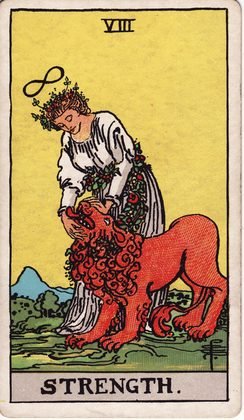
the balance to restore, what is being weighed
One card a day — come back tomorrow.
Illustrations: Rider-Waite-Smith deck (1909), public domain.
It is the exercise readers most often recommend to beginners: one card, no question,
and two lines in a notebook. After three months you will see which cards recur — and more
importantly, how your reading has changed.
Read on
The Marseille Tarot: the full structure, common
spreads, the question of reversed cards.
Learning to read tarot: where to start, and in what
order.
The daily card: how to draw it and record it.
A consultation: what happens in a session, and what it costs
in Switzerland.
Frequently asked questions
Is the draw genuinely random?
Yes, and without replacement: the same card cannot appear twice in one spread, as with a real deck.
Can I draw more than once?
Nothing stops you, but the second spread answers a different question. Redrawing because you dislike the result is the most common mistake.
Why doesn’t the card of the day change?
It depends on the date, not the visitor. A different card on every reload would turn the exercise into a game of chance.
Are my spreads recorded?
No. Everything happens in your browser: no server call, no cookie, no data kept.